 DUMBIO
The Philosophy of Time Respect
Most productivity tools are built around a deceptively simple premise: a list of things to do, with mechanisms to track their completion. This framing is not wrong — but it is incomplete. It treats tasks as the fundamental unit of work and time as a boundless medium through which those tasks move. The result, for millions of people, is a relentless accumulation of undone items, chronic context-switching, and the pervasive sense of falling behind a horizon that perpetually recedes.
“Productivity is not about doing more. It is about choosing, with deliberate intelligence, what deserves the irreplaceable hours of your finite life.”
DUMBIO was designed around a different premise. Its foundational principle — which we call Time Respect — posits that time is not an infinite canvas but a strictly bounded resource. Each working day has an edge, beyond which further cognitive effort yields diminishing returns and erodes the capacity for recovery.
The mission of DUMBIO is to replace chaotic, anxiety-inducing to-do lists with a capacity-based cognitive framework — one that helps people make intentional daily commitments, execute with clarity, and close the loop with honest reflection. The broader vision positions DUMBIO not as a task manager but as an instrument for building the rarest of professional skills: accurate self-knowledge of one's own throughput.
Three Pillars, One Daily Discipline
Every high-performing system — whether an Agile engineering team, a lean manufacturing line, or an elite sports programme — operates through clearly demarcated phases of input, execution, and review. DUMBIO adapts this cadence to the individual knowledge worker through three structural pillars, each designed to eliminate a specific source of cognitive friction.
Pillar I
The Pool
Asynchronous capture — externalise without judgment
The Pool is a frictionless capture space for every task, idea, obligation, and aspiration a user holds. Deliberately non-urgent and non-prioritised, it mirrors the Agile product backlog — a canonical repository of intent that makes no demands on the present moment. By separating capture from commitment, the Pool prevents the anxiety of unprocessed demands from contaminating the execution zone. Tasks remain here until the user consciously decides they belong in today's work. Nothing in the Pool is urgent. Everything in the Pool is available.
Pillar II
The Daily
Intentional execution — commit against capacity, then deliver
The Daily is the execution hub. Each morning, tasks are deliberately pulled from the Pool into the Daily based on one criterion: do I have the capacity to do this today? The Kanban board — three columns of To-Do, In Progress, and Done — provides a clear visual pipeline for the day's work. The system enforces a Daily Capacity ceiling: when accumulated Animality scores exceed the user's declared limit, an overcapacity alert surfaces with actionable options. Tasks completed today remain visible until midnight, preserving the motivational value of tangible progress before moving to Archive.
Pillar III
The Retro
Analytic Feedback Loop — data-driven self-growth
The Retro transforms raw completion data into strategic intelligence. A velocity chart surfaces daily output trends across the last 7 or 30 days; the Zoo Mix reveals how cognitive energy is distributed across task sizes; and the Capability Score provides an empirical daily-throughput baseline derived from the last 14 active days. Where the Daily board records what was done, the Retro answers why output varies — and prescribes where to focus next. Streak counters and weekly growth percentages close the behavioural feedback loop, building the accurate self-knowledge that underlies reliable, long-term delivery. Raw task history remains accessible via the Archive.
Engineering Discipline, Applied Personally
Software engineering teams have spent decades refining Agile methodologies — Scrum, Kanban, Extreme Programming — precisely because raw ambition without structured cadence produces chaos. Sprint planning, velocity tracking, and backlog refinement exist to convert creative intent into deliverable reality. DUMBIO applies these discipline-inducing structures for a radically different context: the individual knowledge worker operating alone, or as a contributor within a larger organisation.
The following table maps each core DUMBIO construct to its Agile engineering equivalent. The correspondences are not superficial metaphors — they are deliberate design decisions, grounded in the same behavioural principles that make Agile teams consistently outperform waterfall ones.
Principle Mapping
In Scrum, the product backlog is the single, ordered source of all work considered for the product. The Pool fulfils the same function at the personal level: a persistent, un-prioritised inventory of every possible commitment, kept separate from the execution context to prevent cognitive overload.
Agile teams estimate effort in story points — relative units capturing complexity, uncertainty, and cognitive weight — rather than absolute hours. DUMBIO applies the same principle through the Animality Scale: a Fibonacci-based sequence (1, 2, 3, 5, 8, 13) represented by six animals. The Fibonacci progression encodes increasing estimation uncertainty as task size grows, forcing deliberate reflection before committing to large items.
A team's velocity is its empirically measured throughput per sprint — the number of story points reliably completed each cycle. DUMBIO introduces an analogous constraint at the individual level: a configurable Daily Capacity (defaulting to 21 points) representing the user's sustainable daily throughput. Exceeding it triggers a visual alert and invites a deliberate trade-off, mirroring the sprint commitment discipline in Scrum.
Kanban's core insight — visualise all work in progress — directly translates to the DUMBIO Daily view. The three-column board (To-Do → In Progress → Done) surfaces WIP at a glance. By making the full day's commitments visible simultaneously, the system naturally discourages multitasking and encourages single-task focus, a practice with strong empirical support in cognitive science research on attention.
A sprint retrospective honestly confronts incomplete commitments and asks: what can we do differently? DUMBIO surfaces the same inflection point each morning through the carry-over modal — a prompt that lists yesterday's unfinished tasks and asks the user to make a conscious decision: recommit, or return to Pool. The friction is intentional. Accountability without blame is the mechanism by which the system builds accurate self-knowledge over time.
The Animality Scale in Detail
Unlike story points — which are abstract numerals — the Animality Scale uses animals as mnemonic anchors for cognitive size. The names are chosen deliberately: a Bird task is lightweight and quick; an Elephant task demands a full day of focused work. This intuitive vocabulary reduces the cognitive effort of estimation itself, enabling faster, more consistent sizing decisions.
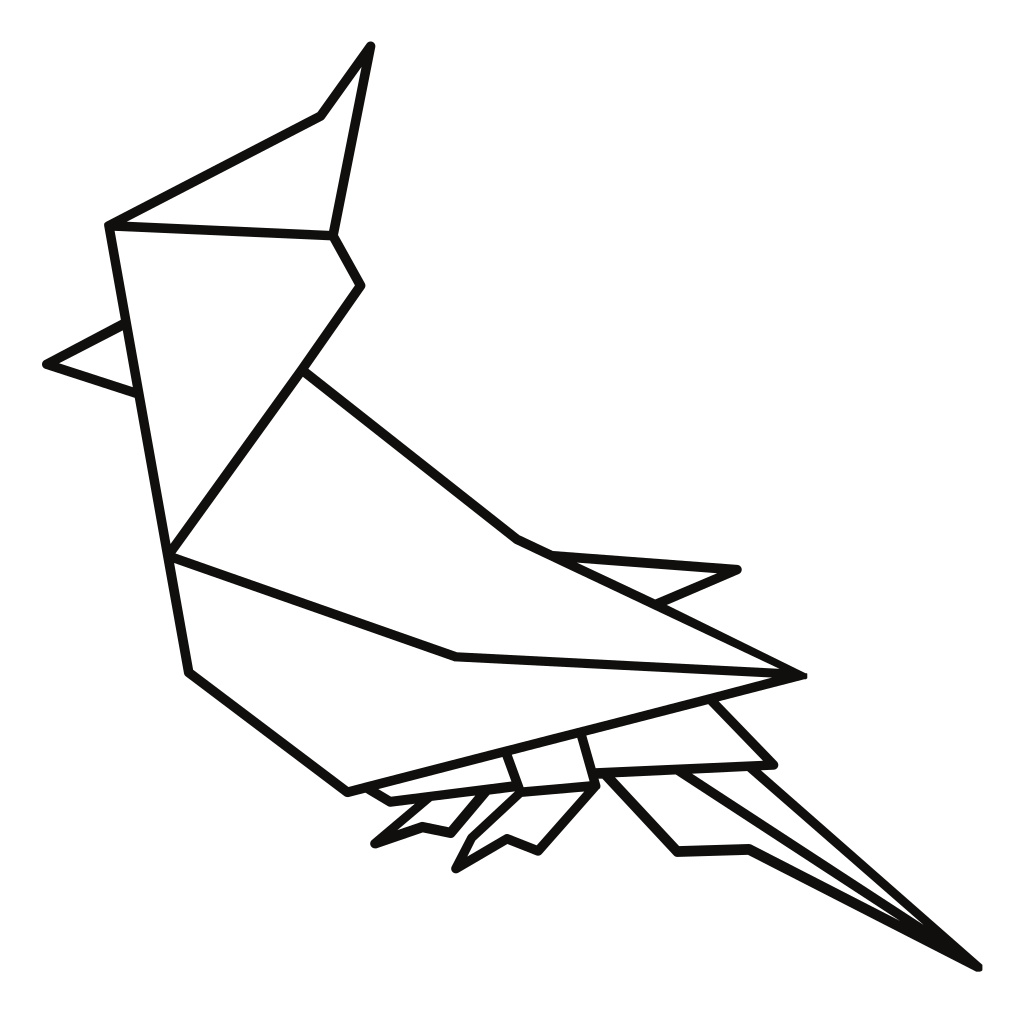 Bird0pt
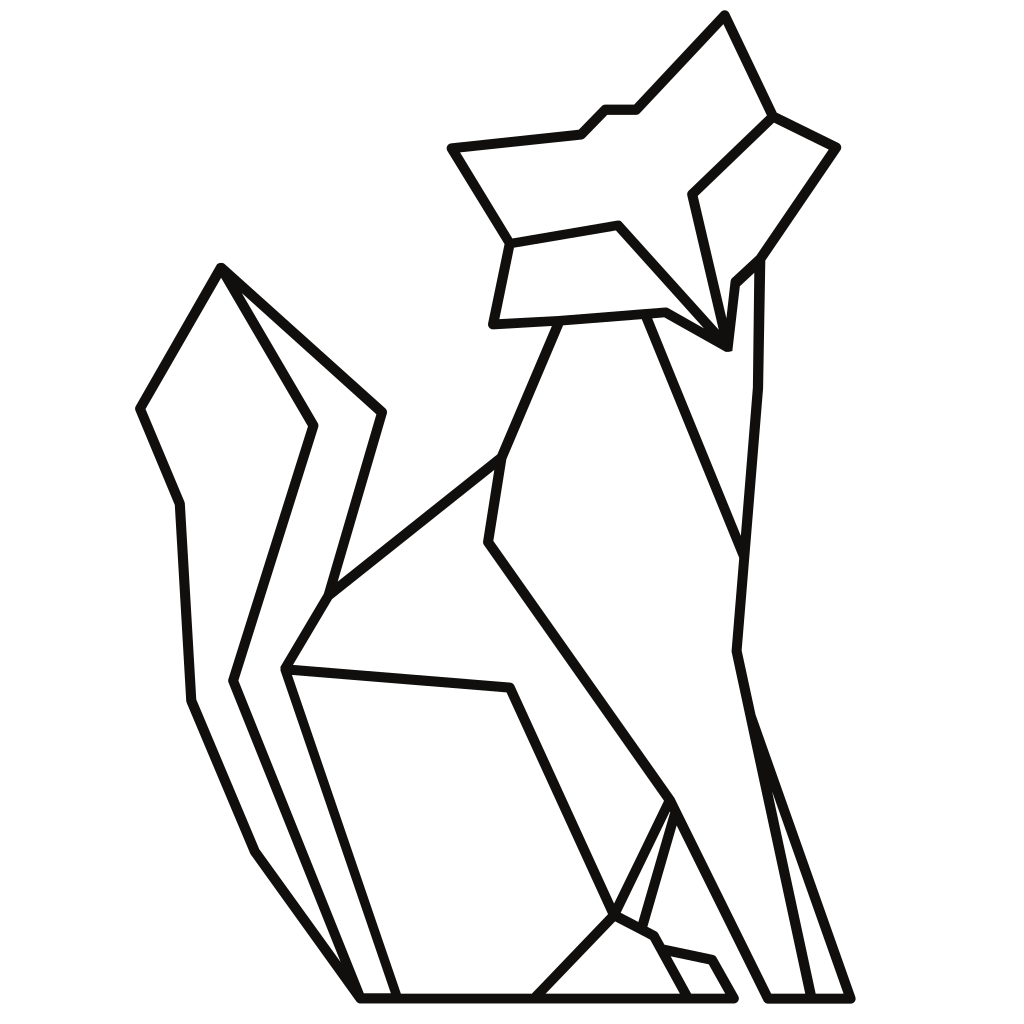 Fox1pt
 Bull3pt
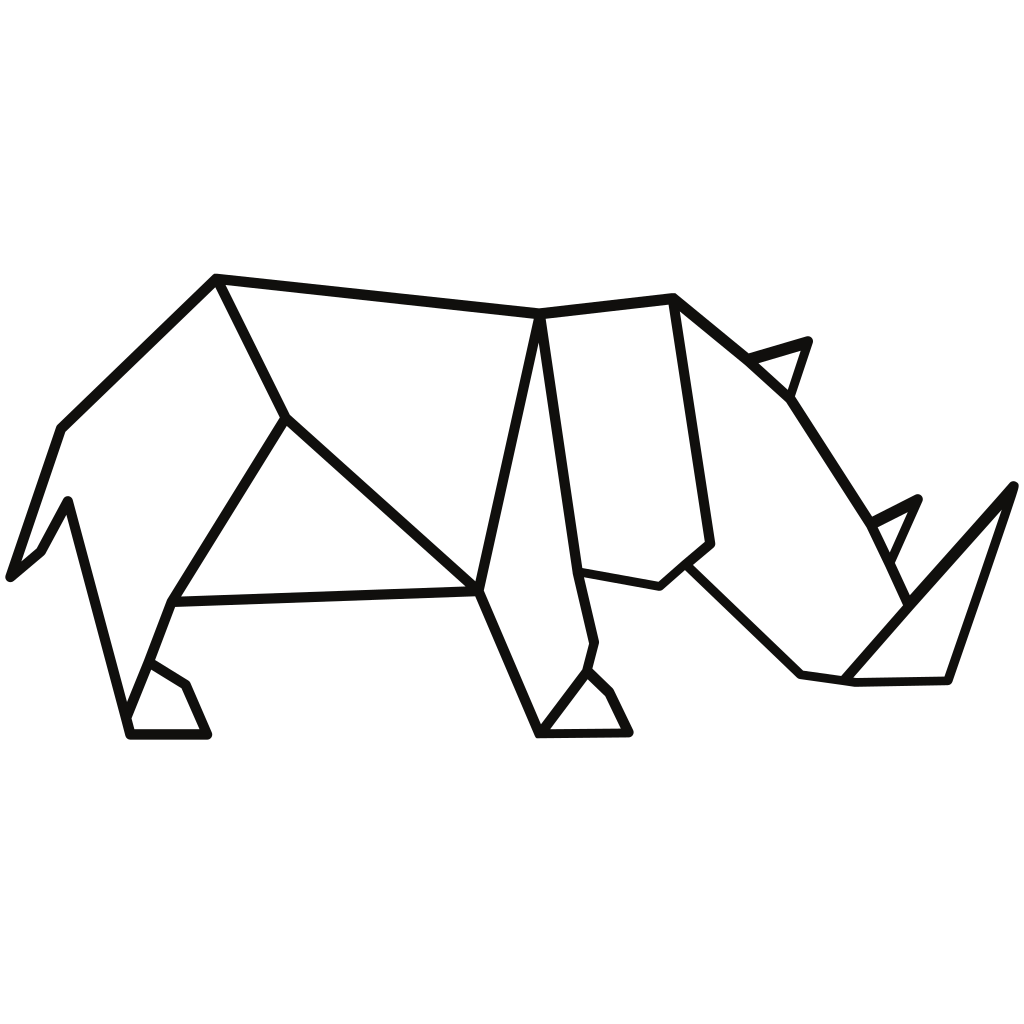 Rhino5pt
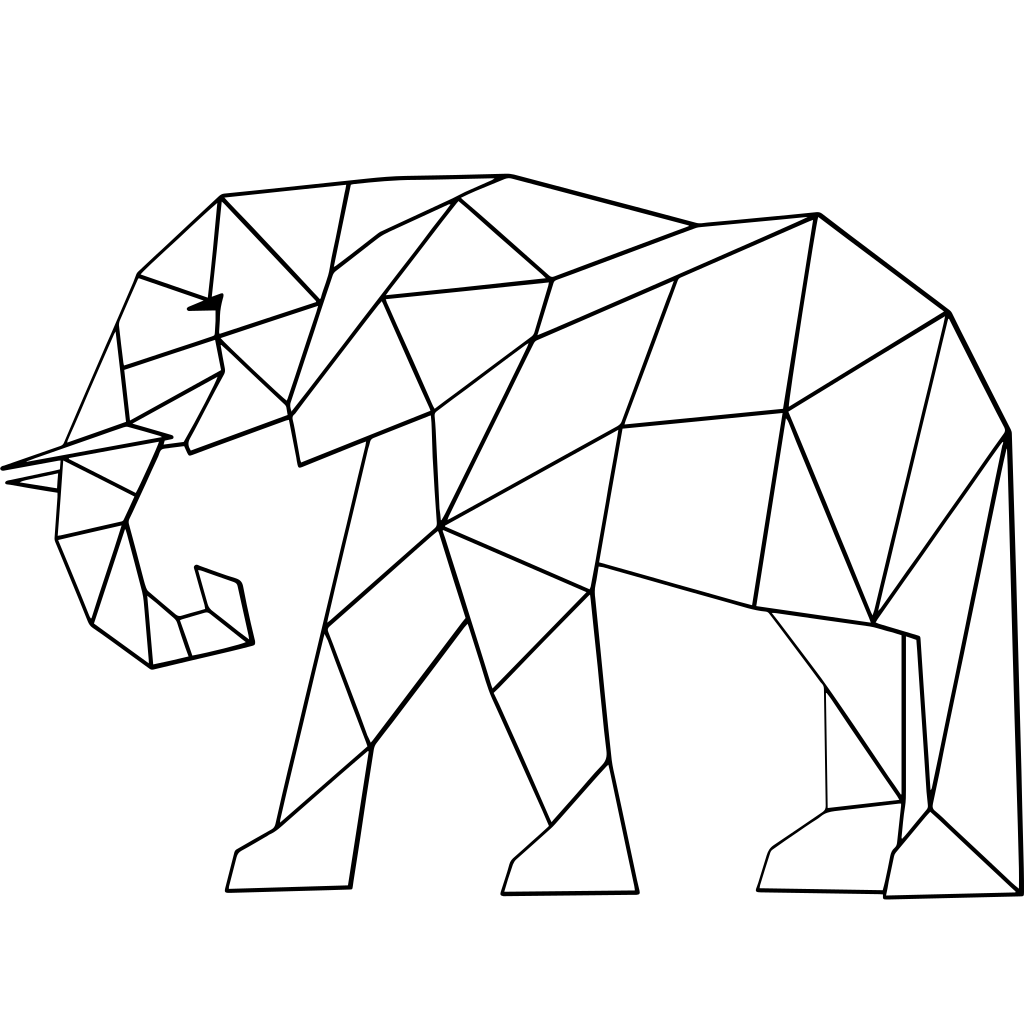 Elephant8pt
Table 1. The DUMBIO Animality Scale — relative effort sizing.
Built From Experience, Not Theory
Roi Le
Technology Project Manager
“The same principles that make engineering teams deliver reliably at scale can make an individual deliver reliably every day — if you take them seriously enough to actually implement them.”
DUMBIO was not conceived in a product sprint or a design thinking workshop. It was developed over years of hands-on experience managing complex engineering applications and large-scale technical integrations — including an extensive IEC background in mission-critical infrastructure systems — in one of the most demanding and compliance-driven environments for enterprise software delivery. A B.Sc. in Computer Science provided the engineering foundation; an M.Sc. in Machine Learning sharpened the data-driven lens through which capacity and estimation problems are modelled.
Managing multi-disciplinary engineering teams across long delivery cycles, the patterns of Agile and Scrum became deeply internalized — not as rigid ceremonies to be performed, but as a philosophy of respecting human capacity. The daily stand-up surfaces blockers, not status. Story points build honest commitments, not performance metrics. The retrospective improves the system, not the individual. These are not process steps — they are human truths, expressed in the language of engineering discipline.
The critical realisation came gradually: most personal productivity tools ignore these truths entirely. They invite unlimited task accumulation without capacity constraints, offer absolute time estimates with no acknowledgement of estimation error, and provide no structured cadence for reflection and recalibration. They are, in the language of Agile, perpetually in a state of unrefined backlog with no sprint planning, no velocity tracking, and no retrospective.
DUMBIO is the answer to a direct question: if I managed my own time with the same rigour I apply to engineering delivery, what would that system look like?
The result is a framework grounded in lived professional experience rather than productivity theory — battle-tested in environments where ambiguity is high, stakes are real, and the cost of poor planning is measured not in missed deadlines but in failed integrations, safety incidents, and regulatory consequences. That professional background in Agile and Scrum is not a reference point for DUMBIO — it is its foundation.
“DUMBIO does not make you work harder. It builds the cognitive infrastructure that allows you to work honestly — constrained by reality, guided by principle, and respectful of the only resource that cannot be recovered: time.”
The methodology described here is a living document. As users build self-knowledge through daily practice, as cognitive science advances, and as the product evolves, these principles will be refined. What will not change is the foundational commitment: that intelligence applied to how we spend our hours is one of the highest forms of professional discipline.